
La pompe à chaleur est devenue un appareil très répandu que l'on retrouve de plus en plus souvent dans les habitations. Elle est très performante par temps froid, lorsqu'elle contribue à chauffer le bâtiment, mais par temps chaud, les résultats obtenus en l'utilisant en mode refroidissement peuvent varier. Cela dépend en grande partie de la manière dont le refroidissement est réparti dans la maison. Le refroidissement via un système à eau, comme le chauffage au sol, le refroidissement par plafond ou les ventilo-convecteurs, fonctionne différemment du refroidissement par air, comme c'est le cas avec un système de climatisation traditionnel de type split ou multisplit. Ce dernier est également une pompe à chaleur, mais d'un type différent. La solution choisie influe non seulement sur la rapidité avec laquelle la température baisse, mais aussi sur la déshumidification de l'air, l'intensité du flux d'air et le niveau de confort obtenu dans la chambre ou le salon. Une pompe à chaleur peut-elle donc fonctionner comme un climatiseur ? Quand un système réversible est-il un meilleur choix qu'un système de climatisation traditionnel ?
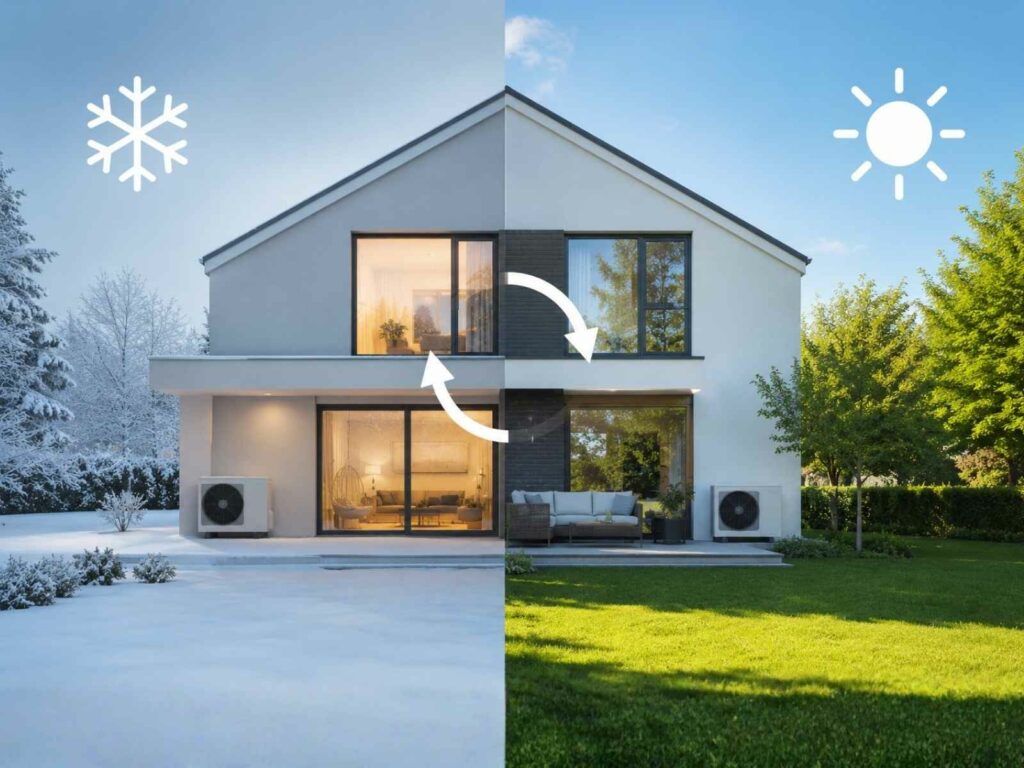
Table des matières
ToggleQu'est-ce qu'un système réversible dans les pompes à chaleur ?
Dans le cas d'une pompe à chaleur, un système réversible signifie que l'appareil peut inverser le sens du cycle frigorifique. Au lieu de capter la chaleur de l'extérieur pour la transférer à l'intérieur de la maison, il évacue, en mode refroidissement, la chaleur de l'intérieur du bâtiment vers l'extérieur. Ainsi, le même système peut assurer le chauffage en hiver et le refroidissement en été, à condition que la maison soit en mesure de répartir efficacement cette fraîcheur.
Refroidissement actif vs refroidissement passif
Le refroidissement par pompe à chaleur peut fonctionner de deux manières : de façon active ou passive. Le refroidissement actif signifie que la pompe à chaleur utilise le compresseur et inverse le cycle, à l'instar d'un climatiseur : elle extrait la chaleur de la maison et la rejette à l'extérieur. Cela procure un effet de refroidissement plus perceptible, mais entraîne également une consommation d'énergie plus élevée, car le compresseur fonctionne pendant cette période. Le refroidissement passif se retrouve principalement dans les pompes à chaleur géothermiques. Au lieu d'un fonctionnement intensif du compresseur, il utilise la température naturellement plus basse du sol comme source de refroidissement, tandis que l'électricité est principalement nécessaire pour faire fonctionner les pompes de circulation et les commandes. L'effet peut être plus doux qu'avec le refroidissement actif, mais il s'agit d'une solution très économique et stable, en particulier pendant les longues périodes de temps chaud.

Climatiser une maison avec une pompe à chaleur
Le refroidissement d'une maison à l'aide d'une pompe à chaleur s'effectue le plus souvent via un système à eau, le même que celui utilisé pour le chauffage en hiver. Concrètement, le refroidissement peut être diffusé par le biais du chauffage au sol, d'installations murales ou de plafond, ainsi que par des ventilo-convecteurs. Chacune de ces solutions fonctionne de manière légèrement différente : les grandes surfaces telles que le sol ou le plafond refroidissent doucement et uniformément, tandis que les ventilo-convecteurs peuvent réagir plus rapidement et offrir un effet plus perceptible, car ils fonctionnent avec une circulation d'air forcée. Dans les maisons conçues pour accueillir une pompe à chaleur et des températures de départ basses, le refroidissement par le sol est la solution la plus courante. Le refroidissement par le plafond ou les murs est plus souvent utilisé lorsque l'investisseur prévoit dès le départ un confort estival et souhaite un refroidissement sans circulation d'air. Les ventilo-convecteurs, en revanche, sont choisis lorsqu'un refroidissement plus puissant est attendu ou lorsque le refroidissement par le sol n'offre pas un effet suffisant, en particulier dans les pièces présentant des apports thermiques importants, comme les combles ou les pièces dotées de grandes baies vitrées.
Dans quels cas un système réversible est-il préférable à une climatisation classique ?
Un système de pompe à chaleur réversible est particulièrement adapté lorsque la maison est déjà équipée pour fonctionner à basse température, par exemple avec un chauffage au sol, un système de chauffage/refroidissement par le plafond ou des ventilo-convecteurs. Dans cette configuration, vous bénéficiez d'un refroidissement silencieux et discret, car il ne repose pas sur un flux d'air puissant dans la pièce. Pour beaucoup de gens, c'est un avantage majeur, en particulier dans les chambres à coucher ou dans les espaces où l'on n'apprécie pas la sensation d'air en mouvement. Cette solution est également idéale si vous préférez une baisse de température en douceur et que votre confort dépend de conditions intérieures stables.
Si vous disposez d'une pompe à chaleur géothermique, le refroidissement passif devient une option supplémentaire. Ce système exploite la fraîcheur naturelle du sol ; la consommation d'énergie est très faible, car le compresseur n'a pas besoin de fonctionner. C'est une solution idéale lorsque vous souhaitez obtenir un effet de refroidissement plus durable.
Un système réversible présente également un avantage lorsque l'on souhaite associer la climatisation à la domotique et gérer la température de manière plus intégrée. Vous pouvez définir des zones, des horaires et des priorités en fonction de la météo et de la présence des occupants, et parfois même relier le fonctionnement au système photovoltaïque afin que la climatisation se mette en marche lorsque l'énergie est la moins chère ou provient de votre propre production. La climatisation s'intègre ainsi dans un système global de confort domestique.
Quand la climatisation traditionnelle sera-t-elle plus performante ?
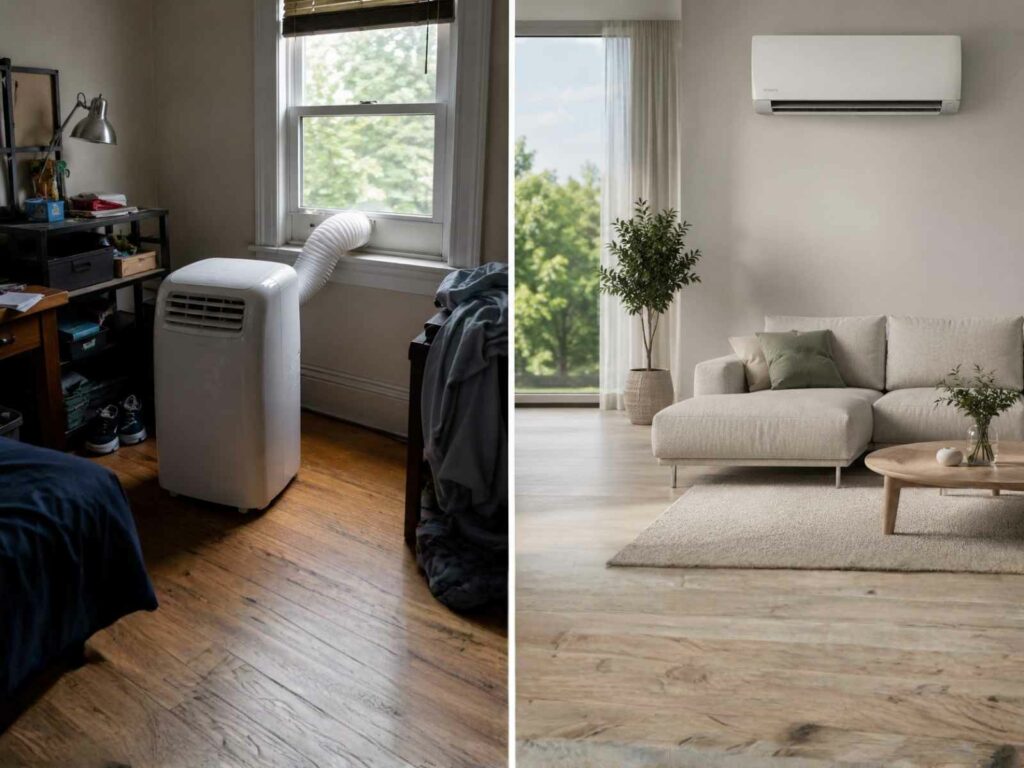
Les systèmes de climatisation traditionnels de type split ou multisplit constituent le meilleur choix lorsque vous recherchez un refroidissement rapide et nettement perceptible, notamment lors des vagues de chaleur ou lorsque vous rentrez chez vous par une journée chaude. Leur principal atout réside également dans la déshumidification de l'air. En été, cette fonction améliore considérablement le confort et contribue à réduire la sensation d'étouffement. Ce système est particulièrement efficace dans les pièces où les apports thermiques sont importants, comme les combles, les salons exposés au soleil ou les pièces dotées de grandes baies vitrées. Dans ces espaces, le refroidissement par le sol ou par le plafond peut s'avérer trop doux et trop lent à réagir. Si votre priorité est un effet de refroidissement puissant, un contrôle de l'humidité et un résultat prévisible, la climatisation traditionnelle sera généralement le choix le plus sûr.
How to choose a home cooling solution?
Lorsqu'on choisit un système de climatisation pour son logement, il est utile de commencer par se poser une question simple : qu'attendez-vous en été pour garantir votre confort ? Si vous privilégiez le silence, l'absence de courant d'air et une baisse progressive de la température dans toute la maison, la climatisation à eau est la solution la plus judicieuse, qu'il s'agisse de systèmes au sol, muraux ou au plafond, ou encore de ventilo-convecteurs. Si, en revanche, vous recherchez un effet rapide par temps chaud, un air nettement plus frais et une déshumidification, un choix plus sûr sera la climatisation air-air sous la forme d'un système split ou multisplit. Et si vous disposez d'une pompe à chaleur géothermique, il vaut la peine d'envisager le refroidissement passif, car il peut offrir un refroidissement stable et progressif avec une faible consommation d'énergie.
Pour faciliter la comparaison, voici un bref aperçu des options les plus courantes :
Solution | Confort et rapidité | Déshumidification | Risque de condensation | Bruit | Coût d'installation | Effet typique |
|---|---|---|---|---|---|---|
Refroidissement par le sol | Doux, plus lent | Généralement limité | Plus élevé, nécessite un contrôle du point de rosée | Très silencieux | Faible si le système existe déjà | Baisse de température douce, confort stable |
Ventilo-convecteurs | Plus rapide que le refroidissement par le sol, plus perceptible | Possible, selon le modèle et les réglages | Plus faible qu'avec le refroidissement par le sol, mais l'eau de condensation nécessite un drainage | Le ventilateur est audible | Moyen | Refroidissement de la pièce plus perceptible, meilleure réponse aux vagues de chaleur |
Climatisation split | Effet le plus rapide | Oui, de série | Faible pendant l'utilisation | Le flux d'air intérieur est audible | Moyen à élevé | Refroidissement et déshumidification puissants, bon contrôle de la température |
Comment Voltmax aide-t-il à choisir un système de climatisation avec pompe à chaleur ou climatisation classique ?
Voltmax vous aide à choisir une solution de climatisation adaptée à votre logement et qui vous apporte un réel soulagement en été. Nous commençons par évaluer le bâtiment et ses apports thermiques, c'est-à-dire ce qui chauffe le plus l'intérieur : le vitrage, l'exposition au soleil, les combles, l'isolation et l'utilisation des pièces. Sur cette base, nous proposons la solution adaptée : un système de refroidissement à eau via une installation existante, des ventilo-convecteurs là où une puissance plus importante est nécessaire, ou un système de climatisation split traditionnel lorsque des résultats rapides et la déshumidification sont prioritaires.
Le contrôle est également un élément essentiel : nous sélectionnons les paramètres de fonctionnement, le contrôle de l'humidité et la protection contre la condensation afin que le refroidissement soit sûr et prévisible. Nous nous chargeons ensuite de l'installation, de la mise en service et de la configuration du système pour que les appareils fonctionnent de manière stable, sans fluctuations inutiles et sans déception lors des journées les plus chaudes. Nous serons ravis de vous proposer une solution de refroidissement sur mesure, adaptée à votre logement et à votre mode de vie. Contactez-nous !