

An electric car is, in practice, a large mobile battery. Increasingly, the point is not only to charge it, but also to use it whenever electricity may be needed somewhere other than for powering the vehicle itself. This is the idea behind bidirectional energy flow: energy can flow not only to the car, but also from the car. It is worth understanding what Vehicle-to-Load (V2L) is, meaning the powering of external devices using energy from the car. It is also important to know that the same concept has two further variants: Vehicle-to-Home (V2H), meaning powering a home from the vehicle, and Vehicle-to-Grid (V2G), meaning feeding energy back into the electricity grid. They differ mainly in their level of implementation: V2L is usually the simplest and often works like a socket in the car, while V2H and V2G typically require compatible equipment, configuration, and formal procedures.
Table of contents
ToggleThree technologies in practice - what are the differences?
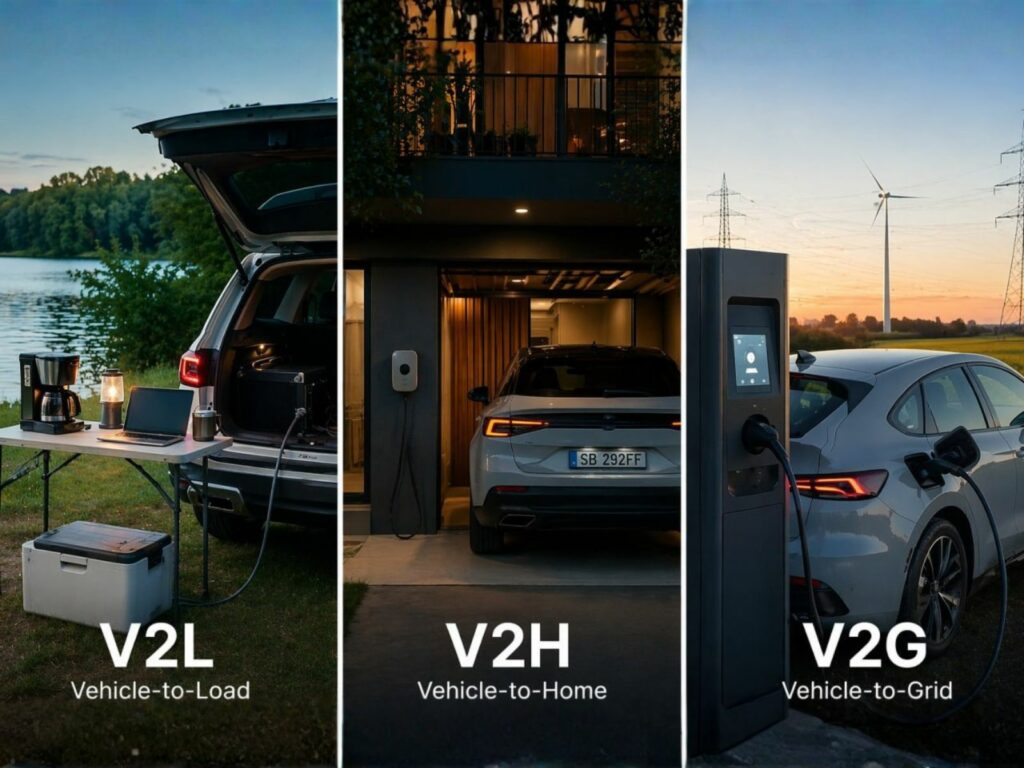
V2L, V2H, and V2G are three names for the same idea: an electric car does not have to be only a consumer of electricity, but can also supply it. The difference lies in where that energy is meant to go and the scale of the overall solution. Below, we present three different technologies worth understanding if you are interested in drawing power from an electric car. The terms V2L, V2H, and V2G refer to the same underlying concept – electricity can flow not only to the car, but also from the car – yet in practice they describe three different use cases.
It is also worth keeping the ISO 15118 standard in mind – this is an international standardization framework that enables the car and the charger to communicate securely (including, among other things, Plug & Charge, intelligent EV charging station management, and preparation for bidirectional charging). From 1 January 2027, stricter regulations resulting from the AFIR Regulation (EU 2023/1804) will begin to apply in the European Union: new and modernized publicly accessible charging points will have to meet interoperability requirements, which in practice means the need to support EN ISO 15118-20:2022 (in accordance with the timeline described in the implementing/delegated acts under AFIR). That is why we are already focusing on equipment prepared for this direction – the Zaptec Go 2 is designed to be ISO 15118-20 ready and V2G-ready, and functions related to this standard are to be activated/developed through updates when the market and operator implementations are ready.
V2L - power from the car to external devices
V2L (Vehicle-to-Load) is the simplest way to use a car as a power source. In practice, some cars simply have a built-in 230/240 V socket, so you can power devices directly just like from a standard wall outlet. However, if you want to connect something larger or your car does not have such a socket, an adapter is usually used instead (for example, from the Type 2 charging port to 230/240 V). This works well at a campsite, in the garden, at a summer house, or while working in the field, and can sometimes also help in an emergency during a household power outage. It usually does not require any building installation – the key factors are what the specific car model supports and which accessories you have available.
You might also like: The Cost-Effectiveness of a Solar Roof Combined with Energy Storage in Luxembourg
V2H - the car powers the home
V2H (Vehicle-to-Home) means integrating the car with the home electrical installation so that the vehicle can act like a home energy storage system. It can supply electricity in the evening, when PV is no longer generating, or provide emergency power during an outage. Usually, it does not power the entire house, but only selected circuits (for example, lighting, the refrigerator, or the router). That is why it requires planning what should remain operational and how to connect it safely to the distribution board.
V2G - the car feeds energy back into the grid
V2G (Vehicle-to-Grid) is the most traditional approach, because the car does not feed energy into the home, but directly into the electricity grid. In practice, this requires compliance with the operator’s requirements and appropriate technical solutions, and often also participation in specific programs or settlement models. Such a setup makes sense mainly where dynamic tariffs or flexibility services are in place, meaning situations in which the grid rewards feeding energy back at specific times. For the user, this means potential financial benefits, but also more formalities and dependence on local electricity market rules.
How does V2H work together with photovoltaics and a heat pump?
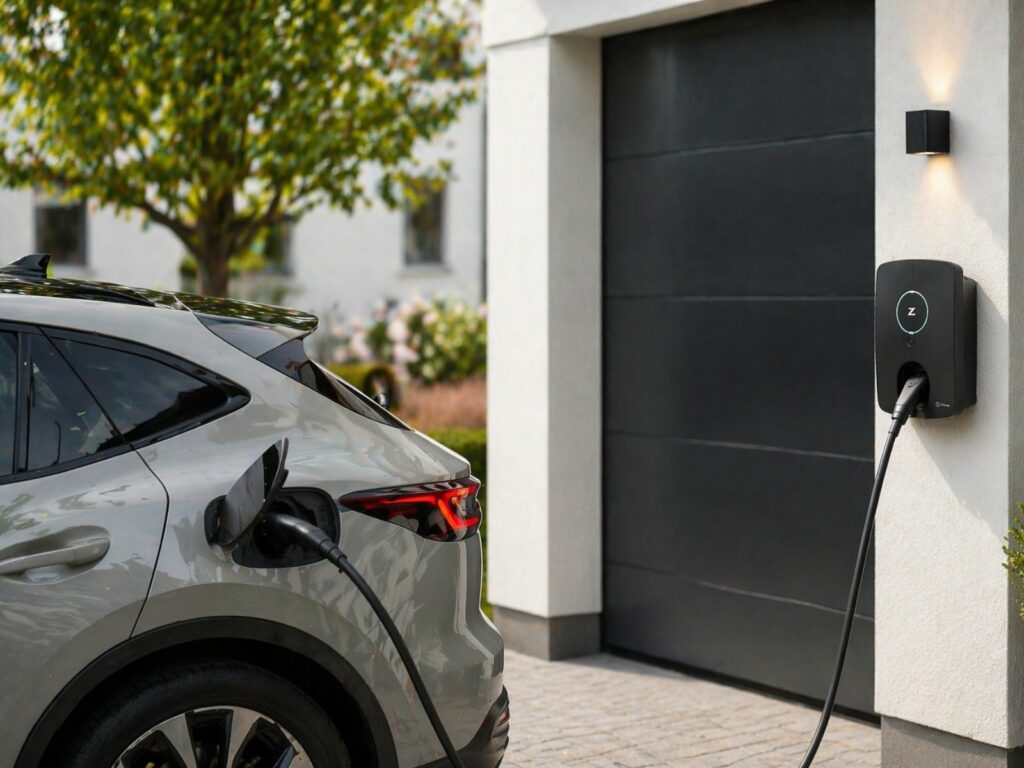
V2H works best with photovoltaics when electricity surpluses are generated during the day, while the highest consumption occurs later in the afternoon and evening. Instead of feeding energy into the grid, you can treat the car as a buffer: charge it with PV power during the day, and then use that energy in the home once the sun is no longer producing electricity. This is a simple way to increase self-consumption and make better use of your own installation. If a heat pump is installed in the home, part of the demand can also be shifted to production hours, for example by heating domestic hot water in the middle of the day or by gentler space heating during transitional periods. In the evening, when demand returns, the car in V2H mode can serve as an energy storage unit. As a result, you stabilize both grid consumption and energy bills.
When is V2H worthwhile?
V2H is most worthwhile when the car is already on site during the hours when the home needs electricity the most. If you have photovoltaics, generate energy during the day, and your highest consumption occurs in the evening, the car can act as a storage unit: you charge it from PV, and then part of that energy returns to the home. In such a scenario, you gain higher self-consumption without having to buy a separate battery – provided that your car and charger actually support V2H.
However, it is worth comparing this with a conventional home storage system. A home battery is usually simpler and more predictable: it works regardless of whether the car is in the garage, charged, or needed for a trip. V2H has an advantage when the car is often parked at home, you have a stable usage pattern, and you want to make additional use of the battery capacity already available in the car. If, on the other hand, the car is rarely at home during the day or often leaves in the evening, a conventional storage system may prove more practical because it is always available.
What does a V2H installation look like in a home?
A V2H installation starts with a short consumption audit: when and how much energy the home uses, what is already in place (PV, heat pump, tariff, distribution board), and which circuits are to be backed up in an emergency. Compatible components are then selected – the car must support V2H, and the charger must be designed for it; otherwise, you are limited to conventional charging. The next step is the electrical design: protective devices, the method of switching the power supply, and deciding which circuits will operate in backup mode (usually the essential ones, not the entire house). After installation, the charging and energy export settings are configured, along with consumption priorities, possible power limits, and integration with PV if the system is to operate as a single setup. Finally, testing and commissioning must be carried out, verifying operation during a power outage and in everyday use. This is important because V2H is not a plug-in gadget, but an energy installation that must be designed and implemented safely.
Recommended reading: What to do in case of blackout in Luxembourg?
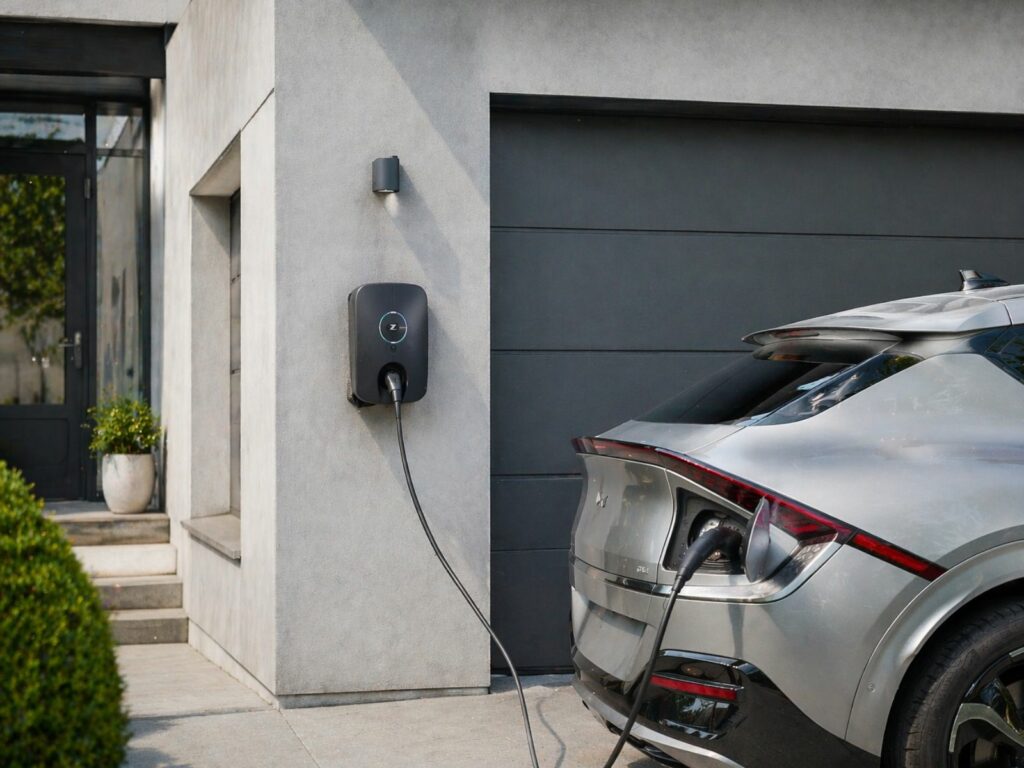
How does Voltmax help prepare a home for this technology?
Voltmax helps approach the subject in a practical way – so that the technology makes sense in your home and delivers a real effect in both energy bills and day-to-day convenience. It starts with selecting and installing an EV charger matched to the electrical installation, connection capacity, and the way the car is used – charging a car overnight from the grid is different from charging it in a way that maximizes the use of photovoltaic energy.
If you already have PV or are just planning it, Voltmax can prepare the installation so that it supports self-consumption and works together with car charging. Keep in mind – when V2H/V2G is not available for your car model or requires too many compromises, a sensible alternative is battery energy storage. It allows you to retain PV surpluses for the evening and improves household independence without making you dependent on vehicle compatibility.