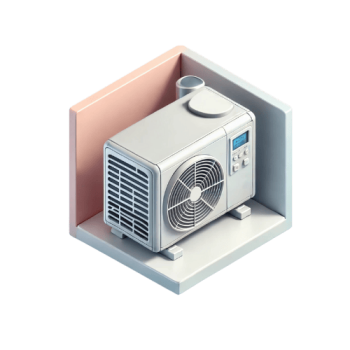


Heating costs in Luxembourg in 2026 can vary significantly. This is only partly related to the choice of heat source-whether it is electricity, gas, oil, or pellets. The price is driven mainly by another key factor: the efficiency of a given system in converting energy into heat. Two houses may pay a similar “fuel price,” yet still end up with completely different bills. Over time, it may turn out that one system has higher losses, while another operates more efficiently.
We compare the most popular heating sources using one common denominator to find out what 1 kWh of real, usable heat in a home actually costs. And to go beyond calculations alone, we will also show an example annual bill for typical energy consumption-so it can be easily related to your own place of residence.
Table of contents
ToggleHow much do you pay for the useful heat that actually reaches your home?
When the topic of heating prices comes up among friends, it often leads to a discussion about which method is cheap and which is expensive. You will often hear that electricity is expensive or that gas is cheap. Such claims usually rely on the energy price on the meter, not on what it costs to produce heat that actually warms the home. So what is useful heat? It is the portion of energy that, after passing through the heating appliance, truly reaches the installation, raising the temperature in living spaces. The rest is lost as waste or escapes during combustion and the device’s own operation. That is why comparing the prices of gas, electricity, or heating oil on their own does not make much sense. After all, different heating systems have different efficiencies. A gas boiler delivers about 92% of the fuel’s energy to the home, while an oil boiler and a pellet boiler deliver about 88%. Electric resistance heating comes closest to 100%. This means, roughly, that 1 kWh of electricity is about 1 kWh of heat.
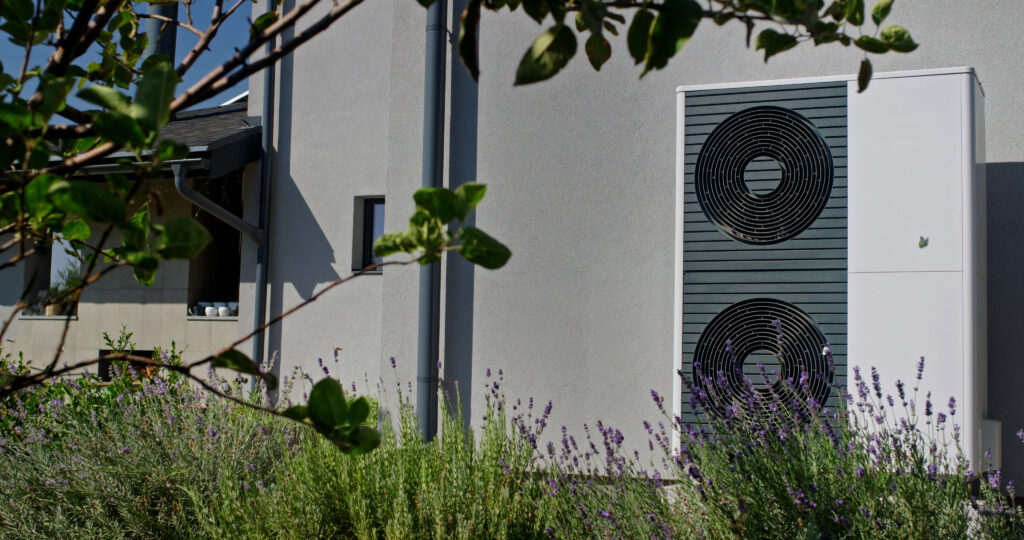
A heat pump works differently-it does not generate heat from electricity, but transfers it. In practice, this means that two people using different heat sources may pay similar amounts for the energy itself, yet their bills will still differ. One buys 1 kWh and gets almost 1 kWh of heat, while the other, using a heat pump, can obtain several kWh of heat from 1 kWh of electricity.
What does SCOP mean, and why does a heat pump “multiply” energy?
SCOP (Seasonal Coefficient of Performance) indicates the average amount of heat a heat pump can deliver over the entire heating season from 1 kWh of electrical energy. This means that with a SCOP of around 3.2, the pump supplies 3.2 kWh of heat to our home from 1 kWh of electricity. That is why it is said that the device “multiplies” energy. It does not produce all of the heat from electricity-it draws energy from the surroundings (air, ground, water) and transfers it to the heating system.
It is worth remembering that SCOP is not a fixed value. A lot depends on the installation in the home and on the temperature at which the heating system operates. A heat pump performs best where heating can run at lower temperatures, e.g., underfloor heating or larger radiators. It then operates much more efficiently. The higher the supply temperature, the harder it is to achieve a high SCOP, which directly affects heating costs.
Energy and fuel prices in Luxembourg in 2026 - reference data for calculations
Price comparisons should be fair, so reference data from specific sources must be collected. These include: operator tariffs, official price lists, and statistics. This is extremely important because the goal is not to guess the amount of a bill, but to build a clear benchmark for calculations. We show real market prices and official starting points-not promises that every household will pay exactly the same. The final result is also influenced by: consumption, tariff, fixed charges, and system efficiency.
For electricity, we use a working assumption of around €0.258/kWh for a household in 2026-an “average” value based on communications about support mechanisms in Luxembourg (for a typical household) and placed in the broader context of Eurostat data for 2025S1. For gas, we use the SUDgaz Classic tariff effective from 01.01.2026 as a reference point. On the tariff page, we find the gas price, the network component, fixed charges, and taxes. All of these components must be included so as not to underestimate heating costs. To convert values from m³ to kWh, we also use the calorific value provided by SUDenergie: 10.2 kWh/m³.
For heating oil, we rely on official prices published in Luxembourg (for example, on 10.02.2026 it was €0.867/l TVAC) and use a practical conversion factor of 10 kWh per 1 litre. We show pellets in two variants, because this strongly changes the result. As a reference point for bulk pellets, we use an example market price for loose/bulk pellets from €373.22/t (update: 01.12.2025)-it is worth remembering that this is not an official price, but a supplier’s offer, and the final rate usually depends on order size and delivery conditions. For retail bags, the price at Hornbach in Luxembourg is €6.79 / 15 kg. For calculations, we assume a typical energy value for pellets of 4.8 kWh/kg-this is an indicative value commonly used in such comparisons.
How much does 1 kWh of heat in a home cost in 2026?
The fairest way to compare different heating sources is to convert them to the cost of 1 kWh of heat that actually reaches the home. This common denominator immediately shows what is truly cheaper to operate-regardless of whether we are talking about gas, oil, pellets, electricity, or a heat pump. Below we present a comparison of the costs of 1 kWh of heat produced using different heating sources.

|
Heating source |
Assumption (efficiency/SCOP) |
Estimated cost per 1 kWh of heat |
|---|---|---|
|
Heat pump |
SCOP 3.2 |
~€0.081/kWh |
|
Bulk pellets |
efficiency approx. 88% |
~€0.088/kWh |
|
Condensing gas (incl. fixed charges) |
efficiency approx. 92% |
~€0.100/kWh |
|
Heating oil |
efficiency approx. 88% |
~€0.099/kWh |
|
Pellets (bags) |
efficiency approx. 88% |
~€0.107/kWh |
|
Electric resistance heating |
efficiency approx. 100% |
~€0.258/kWh |
What is an example annual bill if a home uses 15,000 kWh of heat?
To translate these values into a real-life situation, it is worth looking at an example annual bill. We assume that a home needs about 15,000 kWh of heat per year, which is of course a major simplification. This consumption includes both space heating and hot water. The indicative costs are as follows: a heat pump (SCOP 3.2) is around €1,209/year, bulk pellets about €1,325/year, heating oil €1,478/year, condensing gas €1,506/year, pellets in bags €1,607/year, and electric resistance heating about €3,870/year. This is only an example that shows the scale of the differences. It is worth remembering, however, that the final result always depends on the specific home, the operating temperature of the system, the tariff, and actual energy consumption.
What should you choose to heat a home in Luxembourg?
There are two heat pump placements that practically guarantee that noise will start to bother us when using the device.
The first is placing the unit under a bedroom window. The sound has a very short distance to travel, and at night the pump’s noises become very burdensome. The second place is a corner or the space between walls, the so-called recesses and corridors between buildings. In this case, the noise does not spread naturally—it reflects off hard surfaces and is amplified. Additionally, restricted airflow can cause the device to run at higher speeds, which also increases audibility.
Vibrations and mounting vs sound transmission
In Luxembourg, it is best to base your heating choice not only on the fuel price, but on how your home works: what the insulation is like, what radiators you have, what supply temperature is needed, and whether you are planning modernisation for the years ahead. These are the elements that determine whether a given solution will truly be cost-effective, convenient for everyday use, and reliable over time.
In many homes, a heat pump performs very well-especially when the system can operate at a lower temperature, as with underfloor heating or larger radiators. Under such conditions, the pump achieves better seasonal efficiency (SCOP) and heating costs fall. In addition, many homeowners combine it with photovoltaics, which helps control bills even better over the course of the year.
Gas and oil still make sense where a simple “like-for-like” upgrade is important, without major changes to the installation. This is a common choice in older homes that require a higher supply temperature and where replacing the entire heating system would be expensive or technically difficult. In that case, however, it is not only the fuel price that matters, but also fixed charges and future cost volatility.
Pellets, in turn, are a sensible option for people who have space to store fuel and accept a bit more logistics related to deliveries and boiler operation. Pellets usually deliver the best cost results when purchased in bulk and in larger quantities, rather than in retail bags.
In practice, the most important question is not “what is the best?”, but “what makes sense in my home and for how I use it?”.
Heating costs for your home - compare them with Voltmax
General cost comparisons are a good starting point, but the final decision should be made after carrying out specific calculations. That is exactly why at Voltmax we prepare a comparison of heating scenarios tailored to your home-so you can see not only the fuel price, but above all the real cost of heating in practice.
We start our work by conducting an interview about the building-we collect information such as floor area, insulation, type of installation, supply temperature, and previous bills. We perform an initial calculation of heat demand and calculate the costs for different options. We compare gas vs. a heat pump, pellets vs. a heat pump, or a heat pump combined with photovoltaics. In our calculations we include what truly affects the result: equipment efficiency, the heat pump’s SCOP, fixed charges (e.g., for gas), tariffs, and the way the fuel is purchased (e.g., bulk pellets vs. bags). With such calculations, you gain information on the estimated cost per 1 kWh of heat and an indicative annual bill prepared for your real home, not for an example building. This is especially important because the same system can produce completely different results in two similar homes-for example due to differences in insulation or the operating temperature of the installation.
We also help with the next step, namely selecting the equipment and configuring the system. One solution makes sense with underfloor heating and a low supply temperature, while another makes sense with an older radiator-based installation where the modernisation is meant to be as straightforward as possible. If you plan to combine heating with photovoltaics, we take that into account in the comparison and show how it may affect annual costs.
Voltmax also supports you with formalities and available funding options. Thanks to this, you gain knowledge based on current figures and rules. This enables a faster and easier decision on which solution will be more cost-effective-and, above all, convenient in your home.
Do you live in Luxembourg and want to optimise the heating costs of your home? Write to us! We will be happy to select the right solution to help you optimise your costs. You are welcome!