
A heat pump is a device that generally does not bother anyone—it is not too loud, so it should not cause conflicts. However, in certain situations its placement and installation can be quite troublesome and negatively perceived by residents of nearby homes. It does not matter whether the device is branded and exceptionally high-quality—if it stands in a corner between walls (here the sound strongly reflects and carries) or too close to the property boundary—such a device can be annoying. We are in the same situation if our heat pump operates under the bedroom window—ours or the neighbor’s. You could say the installation behaves like a small “speaker” for the surroundings. Besides the fan noise, the unit may produce other sounds, such as humming or transmitting vibrations into the building structure. The problem can intensify at night—when it is quiet outside, even a moderate sound becomes much more audible, and additionally on frosty days the device’s operation can be more intense.
The good news is that most modern devices are already quite quiet and do not exceed the level of a normal conversation. In most cases, noise issues can be eliminated without “expensive tricks”. You just need to think of the heat pump as a device that must be wisely integrated into the property: choose the right location, ensure vibration damping, and avoid creating conditions in which sound will be amplified.
Table of contents
ToggleWhich heat pumps are quieter, and which require more attention?
Whether a heat pump is quiet or loud depends primarily on where the sound source is located. The loudest will be devices that perform most of their work outdoors. This way we can hear the compressor and the fan working in the open air. Heat pumps enclosed in technical rooms will behave much more quietly. The devices that require the most attention are those that have an outdoor unit. It is the most audible to the surroundings—this applies to both air-to-water and air-to-air heat pumps. Ground-source heat pumps, on the other hand, do not need an outdoor fan—their operation takes place mainly inside the building. Here, proper soundproofing of the technical room and correct decoupling of vibrations from the floor and walls are important.
A separate category includes systems with several units, also called cascades. Here, there may be a risk of sound adding up from each unit. More often, there is also a situation in which one unit goes to higher speeds while the others operate steadily and calmly. It is important to prepare the design of the system layout and its control well.
In the table below, we present a summary of how the different types of heat pumps differ from each other:
Type of heat pump | What can you usually hear? | Where does the problem appear? | What most often helps? |
Air–to–water | fan noise, compressor operation; sometimes a temporary increase during defrosting | corners and recesses by walls, spots under windows, façade mounting that transfers vibrations | a good location (no reflections), stable foundation + vibration isolation, night settings and calmer controller operation |
Air–to–air | fan + compressor in the outdoor unit; variable operation depending on load | small plots, close to the boundary, placement in a “corridor” between buildings; audibility at night | sensible location, vibration decoupling, avoiding covers that block airflow, optimally set night mode |
Ground-source | mainly sounds from the technical room (compressor, accessories); usually little outside | vibration transfer to slabs/walls, overly “rigid” mounting in the boiler room, too close to bedrooms inside the house | good internal mounting (decoupling), attention to the acoustics of the technical room, proper routing of pipes |
Cascade (multiple units) | sound addition from multiple sources; one unit may periodically operate louder | tight development, limited installation space, unfavorable control (frequent “boosting” of speeds) | acoustics-oriented layout design, spacing units out in the area, good control and schedules, possible screening solutions where they make sense |
dB level in the catalog vs real noise
In catalogs that contain descriptions of heat pump models, we can often find information about how quiet a given model is. Phrases about a silent mode or the famous wording “super silent” are repeated. However, it is worth remembering that in the catalog we find information about a device that operated under specific conditions. There is no guarantee that on your property it will operate just as quietly. This causes many disappointments, because two heat pumps with similar data in the documentation can in practice operate completely differently. This depends primarily on the location and surroundings, but also on the installation method.
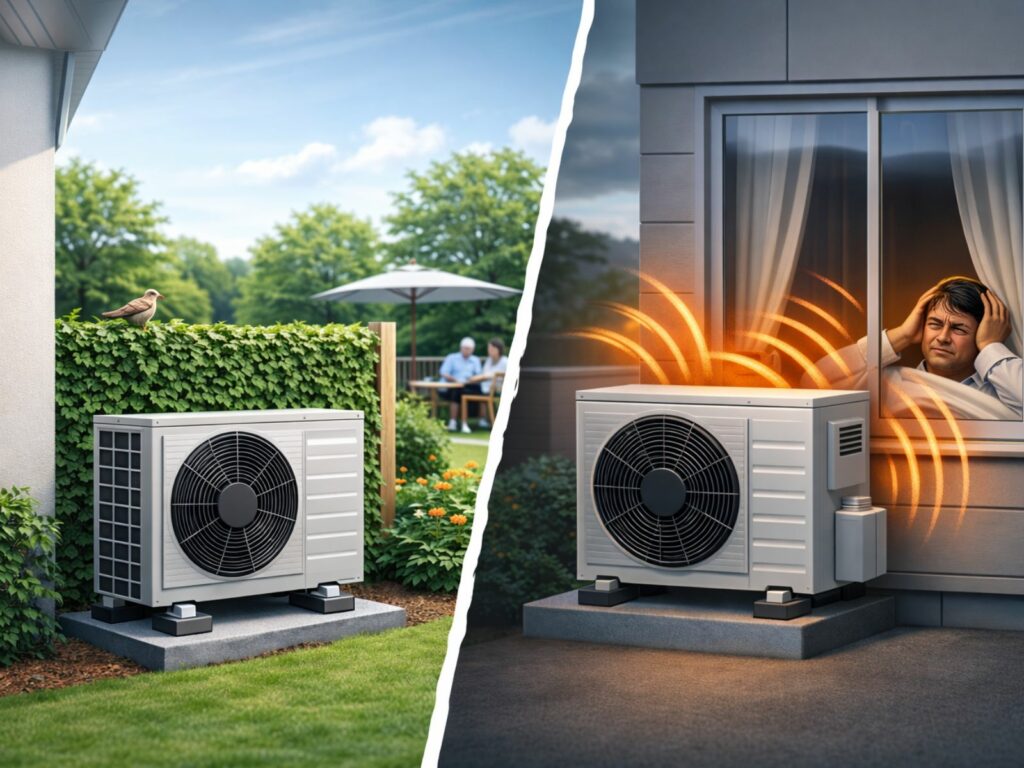
A parameter in the catalog is not the same as the real noise at the place where we are. The perception of loudness is influenced by many factors, such as the distance from the noise source, the direction of the fan discharge, and the surroundings. Sound most often reflects when the outdoor unit stands close to a wall, is located in a corner, or in a narrow passage between two buildings-such conditions work like a megaphone, amplifying the noises produced by the device. It is worth remembering that it is not the pump that works louder-rather, the conditions cause the sound to carry farther or be concentrated in one direction.
The time of day also has a huge impact on how we perceive the sounds produced by a given heat pump model. During the day, background noise—cars driving, people talking, or other city sounds—masks the noise coming from the device. At night, most of these sounds disappear, so the body perceives the heat pump’s operating sound much more clearly. Additionally, during colder nights the device may operate more intensively. All of this means that what during the day seems practically inaudible may bother us at night.
Where does the noise in a heat pump really come from?
A heat pump is a source of various sounds that can appear during different stages of the device’s operation. One day we will not hear it even for a moment, and another day the humming during its operation will catch our attention. In heat pumps, most often three noise sources are involved.
The first is the fan in the outdoor unit—in the case of air-source heat pumps. It produces a steady sound of air noise that resembles a stronger air blow. The fan itself is quite quiet, but the placement of the device plays a big role here. If the pump stands too close to a wall, in a corner, or in a place with restricted airflow—we may encounter audible noise that over time turns into whistling or vibrating. This is caused by the fact that the air reflects and swirls.
The second source of noise is the compressor, which is the heart of the device. The sound coming from it is low, resembles humming, and is particularly audible during changes in speed. The loudness of the compressor’s operation is usually not a problem. The problem arises when vibrations transfer to the structure, which causes the sound to spread through the building. Sometimes this noise can also appear inside the building. The house begins to act like a resonant box and the device’s loudness becomes problematic.
The third source of noise can be moments when the heat pump does not operate evenly. A good example here is the operating cycle called defrost, i.e., defrosting. It activates in cool and humid weather, which causes the device to temporarily change the way it operates. It can increase the speed of both the fan and the compressor. Additionally, there may be sounds related to condensation, dripping, or cracking. It does not last long, but if it occurs at night, it can be noticed.
The moment when it becomes louder than usual
Most often the device starts to operate louder in the case of frost and defrosting-then the heat pump briefly changes its operating mode, can increase speeds, and the sound becomes more audible. This happens especially at night. The second moment is operation at high power-after a break in heating, the house must warm up quickly to reach a specific temperature. Unfavorable controller settings can also unnecessarily increase noise emissions.
Where should you install a heat pump?
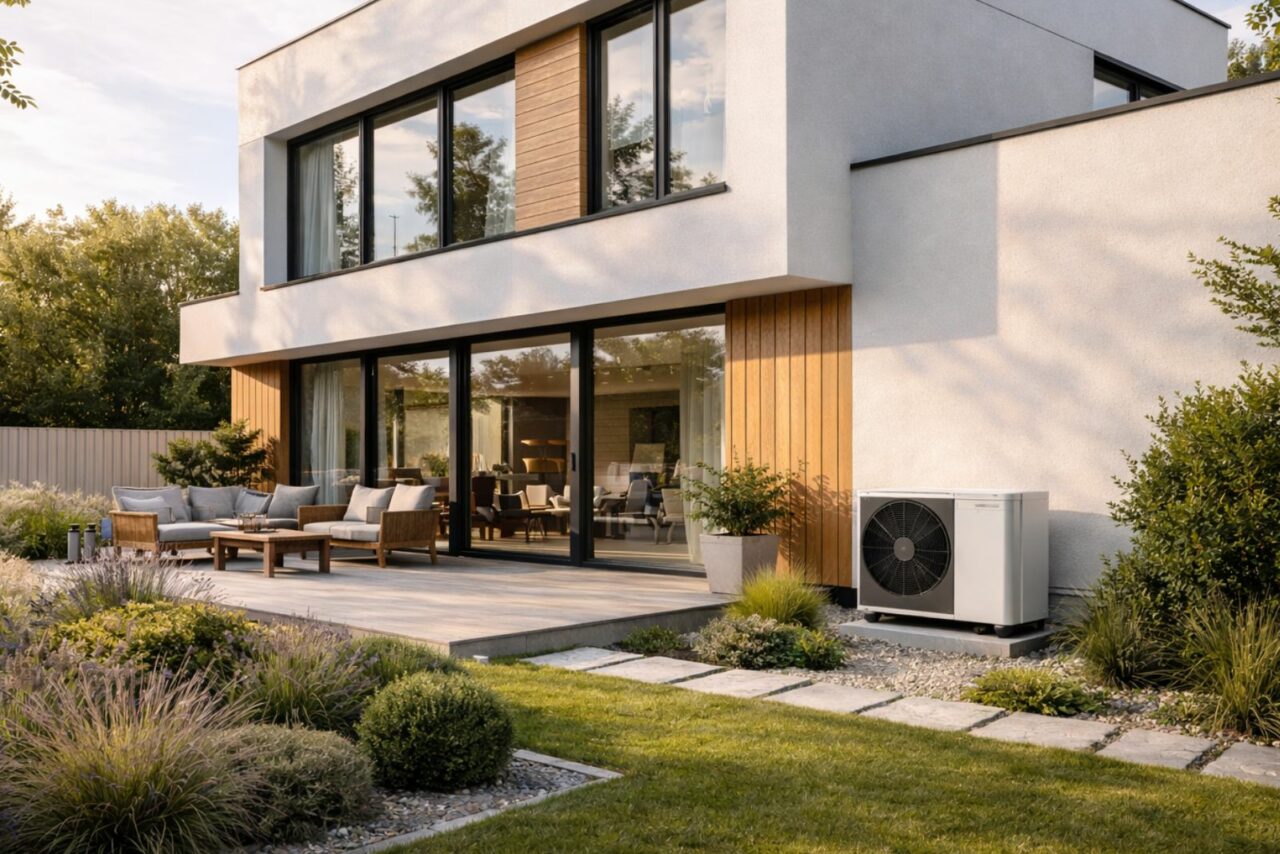
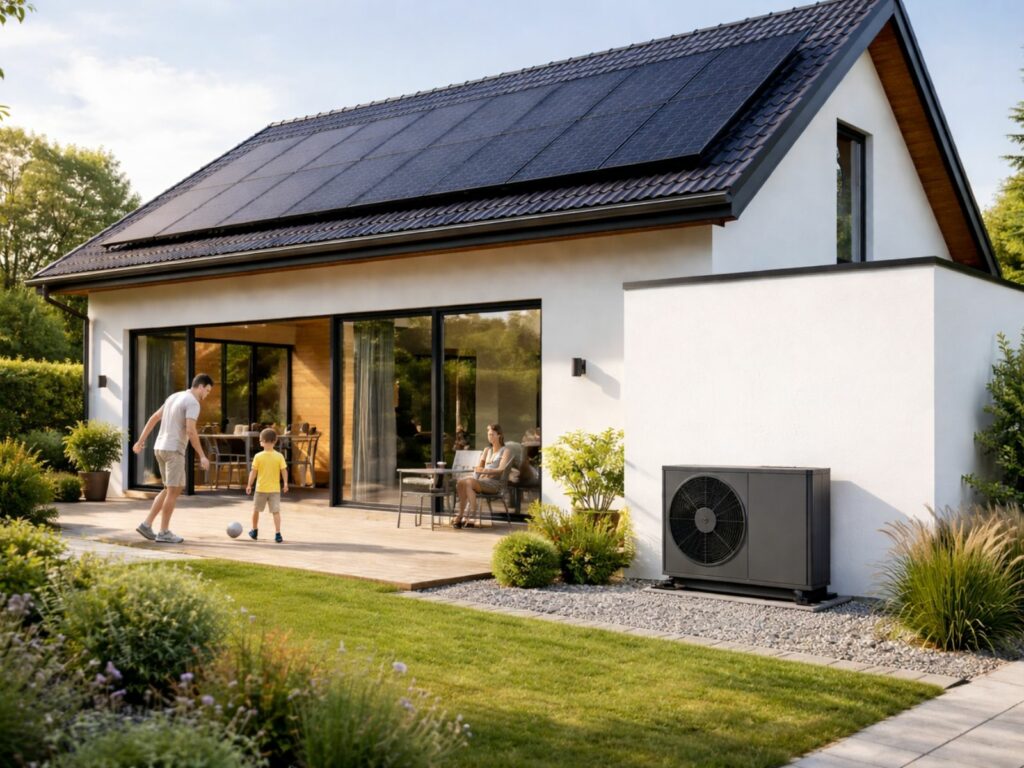
The installation location, or the device itself, is not the problem when it comes to emitting noise. Avoid placing the pump in recesses, between walls, or in corners. These are places that act like a resonant box. The noise is amplified, and the fan noise carries more easily in one direction. If the sound additionally encounters an obstacle such as a wall or a fence, it can reflect and come back, which seemingly increases the noise—we feel that the sound is louder even though the device is operating the same.
It is also worth thinking through the location in relation to windows, especially in the bedroom. The sound produced by the heat pump disappears during the day, but at night it can be distinct. It is therefore good to plan placing the heat pump at an appropriate distance from the house and not necessarily on the side where the windows to our rest room are located. Let us also remember the well-being of our neighbors—try not to place the device in such a way that the noise coming from it disrupts their peace.
Here are a few points worth remembering when choosing the installation location for a heat pump:
- avoid recesses and corners, because they amplify sound;
- position the device so that there is no hard wall opposite it that will reflect the noise;
- pay attention to the direction of the air discharge—it must not be directed toward your windows or the neighbor’s;
- plan a stable base that limits vibrations;
- ensure condensate drainage so that in winter ice does not form under the unit.
Two places where the pump will almost always be louder
There are two heat pump placements that practically guarantee that noise will start to bother us when using the device.
The first is placing the unit under a bedroom window. The sound has a very short distance to travel, and at night the pump’s noises become very burdensome. The second place is a corner or the space between walls, the so-called recesses and corridors between buildings. In this case, the noise does not spread naturally—it reflects off hard surfaces and is amplified. Additionally, restricted airflow can cause the device to run at higher speeds, which also increases audibility.
Vibrations and mounting vs sound transmission
In heat pump noise, what is often the most irritating is not the sounds that are heard outside the building, but those that appear inside the house. We are talking about micro-vibrations generated by the outdoor unit—specifically by the compressor and rotating components. If the installation is done “rigidly”, the building transmits the vibrations further. They turn into a hum that can be felt in rooms inside the house.
The first mistake that should be ruled out is improper seating/foundation. The pump stands on an unstable base, on a light structure, a thin slab, or paving that “moves”, or—worse—on façade brackets without proper vibration decoupling. The result can be that instead of a gentle whoosh you get amplified vibrations at specific frequencies, causing a troublesome, tiring hum transmitted to walls and slabs. To silence this sound, changing the device settings is often not enough—the base and mountings need to be corrected.
The second mistake is poorly selected vibration isolators—either there are none at all, or they are chosen randomly, for example they are too hard or too soft, or simply set incorrectly. In this way, the isolators act like a spring, and the device starts to operate like a swing. This can contribute to one of two scenarios: vibrations can go into the building, causing them to be heard inside, or the unit falls into vibrations that outside sound like buzzing.
The third mistake is vibration bridges in the installation, for example pipes, brackets, or penetrations made rigidly. Even if the heat pump is positioned correctly, vibrations can travel through pipes and mountings into the building structure, resulting in humming—whether in the bedroom or in the living room.
Heat pumps in Luxembourg - what are the requirements?
In Luxembourg there is no golden rule for the entire country that defines one location for the outdoor unit and how far from the fence it should be. The overriding requirements are those defined by a given municipality, i.e., local building regulations (RBVS) and their interpretation. It is at the municipal level that provisions most often appear regarding technical devices outdoors and permissible noise levels. In many municipalities, what matters is what can be heard at the property boundary, not what is presented in the catalog. Therefore, before installation it is worth checking the requirements where you live.
In case of questions from a neighbor or the authorities, it is worth preparing a simple set of documents that will answer most questions. First—noise parameters according to the manufacturer. Second—a plan of the unit’s placement on the plot with marked distances from the boundary and windows. Third—a short description of what has been done to reduce noise. Such measures include proper seating/foundation and all anti-vibration solutions.
Don’t worry about noise, use Voltmax services
Noise when using a heat pump is not the norm. It is usually the result of incorrect placement or vibration transmission. However, a properly selected device and an appropriate location on the property can make the heat pump work excellently-heating the house and not drawing attention to itself.
At Voltmax, we advise on choosing a solution for a specific building. We plan the installation location so as not to direct sound toward windows and neighbors’ houses. During installation we pay attention to the smallest details, such as stable seating/foundation, vibration damping, and correct routing of the system. These are details that later guarantee satisfaction. We also help prepare documentation in a basic version, which in Luxembourg makes the heat pump installation process easier.
If you decide to install a heat pump in your home-contact Voltmax. Describe your house and plot to us, and we will suggest which solution will be acoustically safest and how to plan the installation so that everything goes smoothly and without stress.